Showing posts with label Chagim. Show all posts

Sunday, April 5, 2009

Pesach- Our Blood is not Cheap!


The world's silence is deafening. When Israel finally took measures to protect itself against the thousands of rockets launched against it by Hamas, protests and denunciations broke out worldwide. Thousands of people marched in the streets condemning Israel's offensive and supposed Israeli "war crimes". The media showed a constant stream of crying Arab women, injured or dead children, homes in rubble, accompanied by some Arab ranting about the evil Zionists. Despite a lack of evidence, we were treated to horrendous stories of human rights abuses, of Israeli attacks on ambulances and hospitals, of a "massacre" at a UN school. Based on hearsay and rumours, the New York Times, among many supposedly respectable newspapers, ran front page stories of testimonies of Israeli soldiers intentionally shooting innocent Arabs.

Yet when it comes to the brutal murder of a young Jewish boy by an axe-wielding Arab terrorist, not a peep is heard. Two days ago, an Arab terrorist entered the Jewish community of Bat Ayin and killed 13 year-old Shlomo Nativ, and injured another young boy. It is hard to fathom the level of depravity of someone who can look at teenager, barely bar mitzvah, in the eyes and swing an axe at his head. This is precisely what the wicked terrorist, may his name be accursed, did, nurtured and bred on the hatred and anti-semitism that permeates Arab society. This attack was barely reported in the American or European media. I saw one article hidden in the back pages of the newspaper describing the killing of "settlers", as if somehow a Jew living in Judea and Samaria legitimizes hacking him apart with an axe. The article described the community as very radical. Imagine the twisted logic- an Arab tears a Jewish child apart with an axe and the Jews are called extremists!

Israel has been so demonized and maligned by the media that it is legitimate according to many to kill Jews. A boy being slaughtered by an axe-wielding terrorist is an "act of resistance". The motivation of the terrorist, excuse me, "militant", is sheer desperation over "the occupation" and at the lack of success of the peace process. Totally overlooked is the extreme level of incitement in the Islamic world, total dehumanization of Jews and a religious imperative to slaughter them for a heavenly reward of 72 virgins.

Once again, Jewish blood is cheap. There will be no military reaction to this cruel and brutal murder. Shlomo Nativ's blood cries out from the ground, unavenged. Our "peace partners" understand this loud and clear and know that the world will not bother to lift a finger or even utter its objection to killing Jewish children. The world never changes. And Israel's lemming leaders will look beseechingly to Washington before doing anything.

On Wednesday night, Jews around the world will celebrate the holiday of Pesach which commemorates the Exodus from Egypt. As they have done for thousands of years since we left Egypt, they will sit down with friends and family and retell the story of our going forth from Egypt. For 210 years, the Israelites were oppressed in Egypt, subject to the most harsh of torments, victims of Pharaoh's Final Solution. The Israelites were so utterly degraded and humiliated by the back-breaking hardships of Egypt. If an Israelite slave could not fulfill his mandated quota of bricks, the Egyptian taskmasters would stuff his babies in the walls. Pharaoh would bathe in the blood of Jewish babies as his astrologers told him that this would cure his leprosy.

Finally, after 210 years of abject torture, the message came to Moses: "I have surely seen the affliction of My people who are in Egypt, and I have heard their cry because of their slave drivers, for I know their pains. I have descended to rescue them from the hand[s] of the Egyptians and to bring them up from that land, to a good and spacious land, to a land flowing with milk and honey, to the place of the Canaanites, the Hittites, the Amorites, the Perizzites, the Hivvites, and the Jebusites. And now, behold, the cry of the children of Israel has come to Me, and I have also seen the oppression that the Egyptians are oppressing them. So now come, and I will send you to Pharaoh, and take My people, the children of Israel, out of Egypt." (Ex. 3:7-9) No longer could G-d remain silent and keep His peace. No longer could He bear the sight of Jewish children wantonly killed, or ignore the cries of His tortured people. G-d sent a 10 plagues against Egypt, to humble them and to demonstrate His might.

The final plague that G-d sent against Egypt was the Plague of the Firstborn. G-d sent this plague against every firstborn in Egypt, from Pharaoh's firstborn to the firstborn of foreign slaves and handmaidens. Even the Egyptian slaves were included in this plague because they took pleasure at the torment of the Jews, and rejoiced as the Jews suffered. Because of this, they deserved to be punished. This is what I reply to any Jew who sheds a tear over the "innocent" Arab killed in Gaza, the same "innocent" Arab who danced when Jews were murdered in the streets of Jerusalem, in Merkaz HaRav, in Bat Ayin, in Sderot, and so forth. These Arabs who celebrate and give out candies when Jewish children are killed, on these people we can have no pity.

Our rabbis tell us (Midrash Avchir): "And Israel saw the great hand of G-d' - When the Almighty wished to drown the Egyptians, the Archangel of Egypt (Uza) said: Sovereign of the Universe! You are called just and righteous...why do you wish to drown the Egyptians? At that moment Gabriel rose and took a brick and said: Sovereign of the Universe! These who enslaved Your children such a terrible slavery as this, shall you have mercy on them? Immediately, the Almighty drowned them." Shall we have mercy on those who wish to drive us out from our land, who murder us with suicide bombings, shootings, rockets or axes? Thousands of Israelis will sit around their seder tables and look at the empty chairs of family members, absent because they were killed by Arab terrorists. The Nativ family will mark its seder without their beloved son Shlomo, because he was taken away from them by an Arab.

Every year at our seders, we pause to open the door for Eliyahu HaNavi, Elijah the Prophet, and we raise a cup and declare in full view of the nations, without shame: "Pour out Thy wrath upon the nations that know Thee not and upon the kingdoms that call not upon Thy name; for they have consumed Jacob and laid waste his dwelling. Pour out Thy fury upon them, and may the kindling of Thine anger overtake them. Pursue them with anger and destroy them from under God's skies." We pray that G-d not allow evil to continue unopposed and that the wicked gloat.

Many Jews are uncomfortable with this seemingly primitive call for revenge. We must, however, remember the words of the Passover Hagaddah, "be'chol dor va'dor - And there were those who stood up against us and our forefather, and not one alone who stood against us to annihilate us, but in every single generation, there are those who arise against us to annihilate us. And the Holy One, Blessed be He, saves us from their hands." This is not just a remembrance of a historical event. We are living this passage! Think of the 8 beautiful students killed in Merkaz HaRav, March of last year, or of Shlomo Nativ, killed only because they were Jews. How can anyone not be moved to demand that G-d repay His enemies? How can any Jew not demand that G-d bring the Redemption and usher in an era of morality, where the wicked are humbled and the righteous rewarded?

May this Pesach be a true layl shmurim, a night of protection, for the entire nation of Israel, and may we witness as great miracles as we did when we left Egypt. May we celebrate this Pesach with Moshiach Tzidekeynu, Eliyahu HaNavi and offer the korban haPesach in the rebuilt Temple in Jerusalem. May we see the Final Redemption soon, speedily in our days.
Monday, December 22, 2008

Not Afraid to be Unique


Peled said that Israelis want to celebrate Christmas because they do not want to feel culturally isolated from the rest of the world.

"Celebrating only Hanukka set us apart, makes us different. People don't want to feel that way. They want to be part of world," she said.

With these words, Tamir Peled, has signed the death warrant of the Jewish people. Explaining the increasing visibility of Christmas decorations in certain places in Israel, Peled says that many Israelis don't want to be different. They feel that Chanukkah sets them apart, something that they are uncomfortable with. This desire to fit in, to be alike the nations, is the slow end of the Jews.

The Greeks were one of the most tolerant and universal-minded peoples in the ancient world. It is doubtful that they oppressed or persecuted any other people besides the Jews. How did a people known for its openness and love of philosophy come to commit so many atrocities against the Jews? It is hard to understand how the people that gave the world democracy, Plato and Aristotle, were the same ones as those who murdered Chana's 7 sons before her eyes for not bowing to an idol, or martyred the saintly Rabbi Eliezer for refusing to eat pork.

Alexander the Great and his Hellenistic successors wanted to unite the world under Greek culture and philosophy. The ancient pagans were the ultimate in relativism as they syncretized gods and beliefs with great ease. The Greeks adopted the gods of the nations that they conquered and in return gave them their Pantheon. The only people who refused to do this were the Jews. The Jews insisted on circumcising themselves, alone of all the ancients, did not eat the same food as non-Jews and did not share in any of their customs. The Greeks were outraged when they discovered that the Jewish Temple contained no idol or statue. They forbade the circumcision, the mark of the covenant between the Jews and G-d. They decreed that anyone caught studying Torah, the divine laws, observing the Shabbat, the holy day, or keeping kosher was to be put to death. They outlawed the Sanhedrin's proclamation of the New Month, the obligation which gave the Jewish people mastery over time.

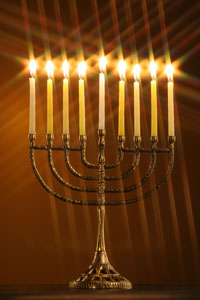
The Greeks did not wish to eradicate the Jews physically, nor did they wish to destroy them. Rather, the Greeks wanted to put an end to the Torah, G-d's laws which set the Jewish people apart. They desecrated the Temple, and erected a statue of Zeus in the Holy of Holies. They built giant sports arenas and theaters in Jerusalem and the countryside to try and entice the Jews into the Greek culture. In fact, many of the rich and elite became known as Hellenizers because of their affinity for the Greek culture. The Greeks polluted all of the oil in the Temple, reserved for kindling the Golden Menorah, symbolic of their desire to stamp out the Torah and its light.

Oil characterized the Jewish people because just as oil does not mix with other liquids, so too do the Jews not mix with other nations. Just as oil always rises to the top, Jews always rise above the mundaneness and triviality of the world, and above the attempts of those who wish to wipe them out. The prophet Bilaam called the Jews "a people that shall dwell alone, and shall not be reckoned among the nations." (Numbers 23:9) The essence of the Jewish people is to be separate, to be distinct and to be holy. The Uniqueness of the Divine is paralleled by the uniqueness of the Jewish people, G-d's chosen vessel through which to reveal His Oneness and Majesty. G-d chose the nation of Israel to bring consciousness of G-d to the entire world, and to spread the light of Torah.

Many Jews unfortunately do not want to be alone. They hate their Jewishness, their choseness and distinct-ness with a passion. Deep down, they are afraid of being unique. These Jews want desperately to be accepted. Little do they realize that it is their Jewish destiny to be different. Our Father Avraham was called the 'Ivri' because he stood on one ever, side, while the entire world stood on the other. In a society that worshipped the forces of nature and paid homage to tyrants, Avraham had the courage to stand apart.

Our Sages tell us that Israel was redeemed from Egypt by virtue of the fact that they retained their identity. The Jews did not change their Hebrew names, adapt their dress to meet Egyptian fashion and spoke only their Hebrew tongue. Throughout the ages, the Jews resisted assimilation and were therefore able to outlast any other nation.

When Jews wish to become like the other nations, it is the beginning of the end. As G-d says: "If you sever yourselves from the other peoples, then you belong to me; but if not, then you belong to Nebuchadnezzar and his fellows." (Midrash, Sifra 93d) In the United States, Judaism is disappearing rapidly in a Silent Holocaust of assimilation, with a 50% assimilation rate. According to research, non-Orthodox Jewry will be largely extinct within the span of 3 generations if the current trend prevails. In Israel, the absurd political situation is a symptom of people of little faith desiring to be accepted by the world. The Israeli government and a large segment of the population are willing to sacrifice land, retreat, withdraw and compromise, all to be accepted by a world that stood silently as European Jewry chocked and burnt in the gas chambers and ovens. Such a government of lemmings is leading the nation of Israel back into the ghettos of exile.

The Jewish nation did not survive 2000 years of exile in order to simply be a cultural club. We are told that G-d created the world for the sake of Israel. In order for G-d's Truth to be revealed to the world, He needs a chosen people dwelling in a holy land living by divine laws. Our ancestors rose up against the Greeks so that they should be able to keep the Torah freely, and not be overwhelmed by Greek cultural influence. "Ye are My witnesses, saith the LORD, and My servant whom I have chosen; that ye may know and believe Me, and understand that I am He; before Me there was no God formed, neither shall any be after Me." (Isaiah 43:10) That is our mission, our calling. Tamir Peled's words, which echo those of the Hellenizers before him, are a death sentence to the Jewish nation.

This Chanukkah, let us discover what makes us unique and may we spread the light of Torah around the world. May G-d illuminate the darkness that clouds of lives, speedily in our days.


Cross-posted to the Truth about Moshiach

Wednesday, December 17, 2008

Don't Let the Light Go Out


Don't let the light go out. This light has seen mighty empires comes and go. It saw the Greece rise up and conquer world, only to fade away. This light saw the Roman empire grown and collapse. It saw mighty rulers, fearless generals and mighty warriors disappear, without a trace. Yet the light remains.

Don't let the light go out. This light overcame the forces of Hellenism and hedonism. It shone through the darkness of immorality and vanity. It gave guidance and meaning to thousands of generations of Jews who resisted assimilation, who refused to forsake their Torah and their G-d. This light illuminated the secularism that blinded many and sought to lead the Jewish people astray. Philosophies, ideologies and 'isms' are relegated to the dustbin of history, yet the light remains.

Don't let the light go out. It was tended and nurtured lovingly by Jews throughout the ages, often at the risk of their lives. It was protected and treasured despite pain, despite poverty, despite hardship and persecution. Downtrodden, humiliated and weak, the light gave us strength. When there was no hope, the light promised us a better future.

Don't let the light go out. It shone brightly in Morocco and Poland, in Baghdad and Paris. It illuminated the streets of Minsk and Pinsk, Istanbul and Fez, Shanghai and Rome. Our enemies could not extinguish it. Withstanding the cross and the crescent, crusaders and mujahadeen, the light still burns. Under the windows of popes and kings, emperors and sultans, shas and dukes, the light proclaimed that we were still here.

Don't let the light go out. It was lit hidden in cellars, for fear of the Inquisitors racks. It was lit in ghettos and camps, in the shadow of the gas chambers and crematorium. It was lit in the freezing gulag's, the punishment for wishing to return home. It burnt long after Crusaders and Almohads, revolutionaries and fascists, Nazis and Communists, disappeared from the earth and will burn long after the suicide bomber, "holy warrior" and jihadist terrorist. For the miracles performed for us in those days, in this time.

Don't let the light go out. The light that was kindled at the rededication of the Second Temple, and will be kindled at the dedication of the Third Temple, may it be soon. The light that has returned home after two thousands years of exile, the light that blossoms in its holy land. The light that was shot out in Mumbai, massacred on the streets on Jerusalem, in pizzerias and cafes, synagogues and study halls. The light that is threatened by assimilation and ignorance. The light that has seen history, yet still shines. Don't let the light go out.

Chag Chanukkah Sameach!


Cross-posted to Goat's Barnyard and the Truth about Moshiach

Sunday, October 19, 2008

Emunah and Bitachon on Sukkot


Today is the second to last day of Sukkot. For 6 days, we have sat in our Sukkah, amidst the cold and chill, shaken by wind and rain, and yet we stand. We have eaten our meals out here. During the week-long chag, we have ventured forth from our warm, comfortable homes to make the sukkah, this little temporary hut, our dwelling place.


The sukkah, its bare walls and schach roof, teaches us that life is temporary. Despite our best intentions to secure ourselves, life is just as shaky and rough as a sukkah.  There was once a man traveling through Europe in the 1800’s. He came to the town where the Chofetz Chaim had lived. The traveler stopped in to meet the great Talmid Chuchum. When he arrived at the house, he saw that the Chofetz Chaim lived in a tiny home. He knocked on the door and when he looked inside he saw a nearly empty one-bedroom apartment. The traveler asked the Chofetz Chaim, “aren’t you the great Chofetz Chaim? How can you live like this? Where are all of your possessions?” The Chofetz Chaim turned to the traveler and posed the same question. “Where are all of your possessions? All you have with you is a suitcase.” The traveler answered, “Well, I am just passing through,” to which the Chofetz Chaim responded, “I too am just passing through.”

Out here, away from our big secure brick walls, we have none other to rely on that HaShem. In the sukkah, we are literally in His presence. It makes us realize how all of the events of our lives, all of the pain, the suffering, the blessings and the harshness, how all of it comes from HaShem. We are required to look upwards and to call out unto Him. In the sukkah, there is no hiding from the Ultimate Reality: HaShem, the One and Only.

The Talmud quotes two opinions as to why we sit in the sukkah. Rabbi Akivah explains that it is because the Children of Israel sat in sukkot when they left Egypt. Rabbi Eliezer holds that it represents the clouds of glory that G-d encircled Israel in during their sojourn in the desert. The Shulcha Aruch, which never holds by the opinion of Rabbi Eliezer, surprisingly agrees with him. So what are the clouds of glory? Why do we commemorate them as opposed to all of the other miracles that G-d performed for us in the desert? The answer is simply. G-d provided the Nation of Israel with heavenly manna and a travelling well of water during our 40 years. And yet we don't commemorate those miracles because G-d had to provide us with food and water. He took us out of Egypt so He had the responsibility of feeding us. But the Clouds of Glory were simply for our own comfort. G-d led us by a pillar of cloud by day and a pillar of fire by night. He flattened out the desert for us, raised valleys and lowered mountains. He did not let our foot falter. HaShem protected us from the elements, made sure that we didn't shvitz or get uncomfortable. The Clouds of Glory are HaShem going the extra mile to show us how much He loves us. So Sukkot is the celebrationg of G-d's love for Am Yisrael.

Yisrael, betach be'HaShem, ezram u'maginam hu. Israel, trust in HaShem, their Helper and Shield. Everything that happens to us comes directly from HaShem, the all Merciful Father. Despite the apparent harshness and injustice of a situation, it is all for the best. HaShem is kind to all and only wants us to grow. Harsh and sweet both come from HaShem as test for out own good.

Chag sameach!

Friday, April 18, 2008

Chag Kasher v'Sameach!


I wish all of Am Yisrael, and the entire world, a happy and kosher Pesach. May HaShem fill every empty seat at the table and send us eternal joy. May HaShem be pleased with our fulfilling of the mitvzah of recounting the Exodus from Egypt. In the merit of our commemoration of the redemption from Egypt, may HaShem send us the Geulah Sheleima in mercy and may our seders be brightened with the glowing countenance of Eliyahu HaNavi and our Righteous Moshiach.

Chag kasher v'sameach!

With love of Israel and Torah,

BK

Tuesday, April 15, 2008

Faster than Time


by Rabbi Akiva Tatz

Both Rosh Hashanah and Passover are beginnings of the year. Rosh Hashanah is the occasion of new creation of the human as an individual; Passover is the occasion of new creation of the Jewish people. What can we learn from this observation?

The spiritual forces operating at Passover time each year are such that the Jewish people -- and in fact any individual Jew -- can achieve the impossible if these forces are used. An attempt to leap up, to reach a whole new level of sensitivity, of personality development, can have a degree of success if undertaken on Passover which may be far more difficult at any other time.

There is a special Divine assistance offered at this time which makes achievement of many levels of growth possible in one leap. Under normal circumstances such levels must be painstakingly acquired in gradual sequence. The very word Pesach -- the Hebrew term for Passover -- means "leaping over"; at a deeper level, the connotation is that of leaping over levels of growth which would ordinarily have to be attained one at a time.

This energy is particularly strong on the first night of Passover. It is a time of most intense inspiration. Mystical sources indicate that on all other nights our ma'ariv (evening prayer) builds certain connections in the higher worlds. On the first night of Passover these are built automatically, our work is not needed.

Why do we pray the evening service on Seder night, then? In order to connect ourselves with what is happening in the higher worlds! To bring down some of those very high energies to our level. This night needs none of the usual protection which night makes necessary -- it is a leil shimurim, a "night of protection." We are Divinely guarded to an extent which never occurs on any other night of the year. It is truly "different from all other nights!"

A DIFFERENT NIGHT

So let us ask, with deeper insight, the old question "Why is this night different from all other nights?"

Using the principles we have discussed previously, we can begin to understand that this night must have unparalleled power: on this night, the first Passover sacrifice was eaten. The culmination of the ten plagues, the smiting of the Egyptian firstborn, occurred at midnight. Our homes were "passed over" by God as He smote the Egyptians, Himself personally and not by means of angelic agents. The Exodus began, the redemption was manifest. The redemption occurred with lightning speed -- k'heref ayin -- like the blink of an eye. There was not time for the bread to rise and it was taken out of Egypt as matzah.

Such events are surely the physical expression of indescribable energies released on the higher plane. What can we understand of the nature of these events and their root? What is the deeper meaning of this speed? Of the nature of matzah?

Let us start by asking a question which has bothered some of the more recent commentaries. There is a well-known idea that the Jewish people in Egypt were on the 49th level of impurity and had to be redeemed, because had they remained in Egypt any longer they would have sunk to the 50th level from which there is no return. The redemption occurred when it did because there would have been no Jewish people to redeem had G-d delayed at all. We were saved at the last moment possible. This idea understands that at the very last moment in Egypt, the moment just before the Exodus, our existence was critically in the balance -- one moment longer and it would have been too late.

The problem is, though: How could one more moment of time in Egypt have caused us to disappear spiritually, to fail and fall into Egyptian impurity? That last moment was the greatest moment we had ever experienced, it was the instant of highest revelation, supercharged with awareness of God's closeness. That moment of midnight was incandescent with purity. It was the climax of a process which had begun months before with the first of the plagues at which time the slave-labor had ended. The subsequent plagues were appreciated by the Jews as ever-increasing revelations of God's guidance of world affairs. This night was the pinnacle of that process.

How is it possible to conceive of the imminent disintegration of the Jewish people into impurity and oblivion by a prolongation of that state of being? It would seem that more of that intensity of revelation would have transformed people into angels!

The sources which deal with this idea understand that what is being referred to here is literally one more moment in that state. Not more time in the previous phase of slavery and persecution in general, but very specifically more time on that last night in Egypt. What is the answer to this problem?

TRANSCENDENT BEGINNING

An approach to this question is found in the deeper Jewish sources. There is an idea that one can live in the physical dimensions of space and time and be subject to them, part of them. Or one can live within them and yet transcend them. To do this, one must minimize the contact between oneself and the physical elements. In the time dimension, this is known as z'rizus -- zeal or alacrity -- in performing God's commandments.

The 16th century Maharal explains that if one moves fast, minimizes the time taken for action, one can overcome the stifling effects of time. Of course there is always a finite time needed for action, but the point is that spirituality is contradicted by unnecessary expansion of the physical dimensions of space and time. The minimum time needed is not a contradiction to spirituality at all, In fact zealous action elevates the physical dimensions to a spiritual level. Since the spiritual world is above time, explains the Maharal, we can make contact with it by coming as close as possible to it by our efforts, by shrinking the physical component of our actions to the absolute essential minimum.

Put another way: Laziness, or the slowing down of action, the expanding of the physical dimensions, makes us part of those dimensions. Sluggishness is the opposite of spirituality. Laziness is incompatible with spiritual growth.

What is meant here is that spiritual life is generated in the almost infinitely short-lived moment of the flash of conception, the male phase of reality. The work of the female phase is to maintain the spiritual energy of that first phase and to bring it into the finite world. But this can be done only if the creative conception phase is electric, alive, unburdened by physical heaviness.

Let us return to that moment of midnight in Egypt. The problem with more time in Egypt would not have been the contaminating effects of Egyptian impurity. That danger had long since ceased. No, the problem with more time in Egypt would have been more time itself!

Let us strive to understand. The redemption had to occur k'heref ayin, in the blink of an eye, because that alacrity is necessary for an event to remain spiritual. Had we left Egypt slowly, naturally, in a relaxed fashion, we would have been a natural people! The Jewish nation was being born then; the moment of birth had to be transcendent because "Everything goes after the beginning." We became and remain a spiritual people because our beginning was spiritual. Our moment of formation occupied the absolute minimum of time, and since then we have lived on the edge of the physical universe, at that edge which interfaces with the transcendent, the Divine.

The terrible danger of more time in Egypt would have been the time itself; that is the impurity which is meant here, the impurity of a nation destined for spirituality becoming merely physical, merely natural.

OVERRIDING TIME

And that is the secret of Passover -- riding the wave of minimum time. Overriding time. We left Egypt too fast for the natural to take effect. Too fast to be in danger of becoming slowed by friction with the natural world. Too fast to be slowed into the material and the finite. Too fast for dough to rise, for the food which sustains our lives to expand into the swollen, bloated dimension.

A people only just within the physical, sustained by a food which is only just the sum of its ingredients.

If we think a little further: what is matzah, one of the central commandments of Passover? What is the difference between chametz (leaven) and matzah? Only time! Not a difference in ingredients, only a difference in time. Flour and water if baked within a certain minimum time become matzah. A second's delay beyond that minimum: chametz.

And what a difference: eating matzah is a positive mitzvah of the Torah, its reward is immeasurable. Eating chametz is a prohibition of the Torah and its punishment is spiritual excision! Literally the difference between life and death, rooted in a few seconds of time.

MITZVOT AND MATZOT

This is the secret of the statement of the Sages: Mitzvah haba'a leyad'cha, al tachmitzena -- "When a mitzvah, a commandment, comes to your hand, do not let it become stale" (literally "do not let it become chametz, sour"). U'shmartem es ha'matzot -- "And guard the matzot," which can be read as "And guard the mitzvot". No mere play on words; the idea here is that just as matzah becomes chametz if left too long, so too a mitzvah, spiritual life for the one who performs it, becomes chametz, fermented, sour, if it is allowed to become part of the natural.

A mitzvah is a physical action containing unbounded spiritual energy, but it should be performed thus. If it is performed as no more than a physical action, it may lose its connection with the spiritual world. Mitzvot are like matzot: performed at the higher level, with zeal and alacrity, they are transcendent. Performed sluggishly, slowly, they sour.

The first night of Passover. Incredible energy, incredible opportunity. A time of transcendent beginning. A time to inspire children, beginners in spirituality. A time to be inspired. A time to reach for the impossible, to reach above time.

Thursday, April 10, 2008

Archaeological Evidence for the Ten Plagues


I was recently priviledged to read a fascinating book detailing the amazing parallels between ancient Jewish sources regarding the Exodus and Egyptian archaeological records. I highly recommed The Riddle of the Exodus by James D. Long.

While the book presents proof and evidence that is far beyond the scope of this post, I wanted to show proof the the Ten Plagues. In an ancient papyrus, the Egyptain priest Ipuwer presents a lengthy diatribe to the Pharaoh (who certainly is the cause of the Plagues) and laments a series of catastrophes that have shaken the core of the nation. "And Pharaoh's servants said unto him: 'How long shall this man be a snare unto us? let the men go, that they may serve the LORD their God, knowest thou not yet that Egypt is destroyed?'" (Shemot 10:7)

The Torah records:
7:20 "…all the waters of the river were turned to blood."
7:21 "...there was blood thoughout all the land of Egypt …and the river stank".
7:24 "And all the Egyptians dug around the river for water to drink; for they could not drink of the water of the river."

Ipuwer laments:
"Plague is throughout the land. Blood is everywhere."
"The river is blood."
"Men shrink from tasting - human beings, and thirst after water."
"That is our water! That is our happiness! What shall we do in respect thereof? All is ruin!"


The Torah says:

9:23-24 ...and the fire ran along the ground... there was hail, and fire mingled with the hail, very grievous.
9:25 ...and the hail smote every herb of the field, and broke every tree of the field.

9:31-32 ...and the flax and the barley was smitten; for the barley was in season, and flax was ripe.

But the wheat and the rye were not smitten; for they were not grown up.

10:15 ...there remained no green things in the trees, or in the herbs of the fields, through all the land of Egypt.


Ipuwer writes:

"Forsooth, gates, columns and walls are consumed by fire."
"Lower Egypt weeps... The entire palace is without its revenues. To it belong [by right] wheat and barley, geese and fish."

"Forsooth, grain has perished on every side."

"Forsooth, that has perished which was yesterday seen. The land is left over to its weariness like the cutting of flax."


The plague of pestilence:

9:3 ...the hand of the Lord is upon thy cattle which is in the field... and there shall be a very grievous sickness.
9:19 ...gather thy cattle, and all that thou hast in the field...

9:21 And he that did not fear the word of the Lord left his servants and cattle in the field.

Ipuwer continues:

"All animals, their hearts weep. Cattle moan..."
"Behold, cattle are left to stray, and there is none to gather them together."


Darkness:

10:22 And there was a thick darkness in all the land of Egypt

"The land is without light."

The Slaying of the Firstborn:

12:29 And it came to pass, that at midnight the Lord smote all the firstborn in the land of Egypt, from the firstborn of Pharaoh that sat on his throne to the firstborn of the captive that was in the prison.
12:30 ...there was not a house where there was not one dead.
12:30 ...there was a great cry in Egypt.

"Forsooth, the children of princes are dashed against the walls."
"Forsooth, the children of princes are cast out in the streets."

"The prison is ruined."

"He who places his brother in the ground is everywhere."

"It is groaning throughout the land, mingled with lamentations."


The Pillar of Fire:

13:21 ... by day in a pillar of cloud, to lead them the way; and by night in a pillar of fire, to give them light; to go by day and night.

"Behold, the fire has mounted up on high. Its burning goes forth against the enemies of the land."
The Spoiling of Egypt:

12:35-36 ...and they requested from the Egyptians, silver and gold articles and clothing. And God made the Egyptians favour them and they granted their request. [The Israelites] thus drained Egypt of its wealth.

"Gold and lapis lazuli, silver and malachite, carnelian and bronze... are fastened on the neck of female slaves."

There are many more parallels and proofs of the Exodus. Of course, the greatest proof is that for 4 000 years Jews have sat down by the Seder table and repeated the exact same story to their children. This is a chain of a direct unbroken tradition passed down from fathers who saw the events, to their children who in turn passed it down to their children, who passed it down to their children... As soon as the Jews left Egypt, they were commanded to rememeber the Exodus. All of the holidays are designed to commemorate the Exodus. Jews wear tefillin every morning which records the Exodus and have mezuzot on every door to remember G-d passing over the houses of the Jews.


Have a chag kasher v'sameach!

Monday, April 7, 2008

Separation and Redemption


As history has shown, the natural trend of the Jews is towards assimilation. We don't want to be different. We want to fit it, to belong, to be like everyone else. Even when Jews are prepared to assert themselves, we want allies and friends. Many Jews do not see themselves as members of the Jewish nation but rather "Americans (or Canadians, or British, or French) of the Mosaic Persuasion". As the old saying goes, be a man on the street and a Jew at home. Such was the tragic thinking of the Jews in Egypt.

On Pasuk, (Shemot 1:7) "And the land was filled with them (the Jews)," the Yalkut stated: "If the Egyptians went to the theater, it was full of Jews; if they went to the circus, again, the place was full of Jews." As soon as Levi, the last surviving brother, passed away, the Jews moved away from the customs and ways of Ya'akov and moved out of the shtetl, into cosmopolitain Egypt. The Jews began assimilating in ernest. Pharaoh used their desire for integration and acceptance to his own benefit, as he said (1:10), "Come, let us outsmart them." Pharaoh announced a new public works project for the good of Egypt and invited all of the Jews and native Egyptians to participate. Being loyal citizens, the Jews joined with the Egyptians in this new and glorious project. Pharaoh even set the first brick! As all the Jews had gathered to work, free of charge in order to gain acceptance, Pharaoh brought in the taskmasters who forbade the Jews to stop working. He tricked Am Yisrael into slavery!

To the degree which the Israelites tried to integrate into Egyptian society, they were violently thrown out. Being rejected, they turned insular and returned to their roots. The Midrash tells us that in the merit of the Jews keeping their Jewish names, Jewish language and Jewish garb, they merited the Redemption. Assimilation brought slavery and oppression while separation and self-identification heralded divine compassion and great miracles. G-d took the Jewish people out of Israel to separate us from the other nations, to remove us from the influence of idolatry and of wickedness, to end the foreign influence over us.

"And you shall be holy to Me, for I, the Lord, am holy, and I have distinguished you from the peoples, to be Mine." (Vayikra 20:26)

"So I said to you, You shall inherit their land, and I shall give it to you to possess it a land flowing with milk and honey. I am the Lord your G-d, Who has separated you from the peoples." (Vayikra 20:24)

Sadly, the nation of Israel seems intent today on committing the same foolish sin. Hillel, the Jewish organization on campus, has recently announced that it is opening its doors to non-Jews for membership. According to the report, "the organization is throwing open its doors to everyone, designing programs that appeal to Jews and non-Jews and hyping its contribution to university -- not only Jewish – life." Reportedly, more and more non-Jews are serving on Hillel boards. Whereas the group's mission statement before 2006 was to increase the number of Jews "doing Jewish with other Jews," it now seeks to "enrich" Jewish student life, the Jewish people and the world.

"Most of the students that we have are not interested in doing Jewish with other Jews," a Hillel campus head told the Jewish Telegraphic Agency. "They're interested in doing Jewish with their friends who are doing Catholic and Puerto Rican and Turkish -- their friends and their family. The challenge for us is how do you create expressions of Jewish life that students will deem to be authentic at the same time as they are not exclusive or tribal."

Hillel, which purportedly claims to seek to enrich Jewish life on campus and to bring Jews together, is opening the door to assimilation and spiritual destruction. Already, in the United States, every second Jew that gets married is opting out of Judaism, and marries a non-Jew. What is it about Jews that we want to seem tolerant and accepting at all costs, even putting ourselves at jeopardy? (Could it be that being in exile too long has led us to forget that we too have rights?) This is the same dangerous thinking that leads Jews to shun Jewish schools because they are too "sheltered", for the Israeli government to continue its suicidal tendencies at the behest of the United States or to persue policies that put Jewish life in danger in order to gain acceptance by the anti-semitic United Nations. It is this mindset that demands that we continue to allow non-Jews, Evangelical Christians, to support us, even though this gives them a foothold in the Land and brings on the more serious problem of missionization and spiritual erosion.

Jews, we cannot be part of the United Nations, to assimilate among the goyyim. We are a "people that dwells alone and among the peoples is not reckoned" (BaMidbar, 23:9). This is a mitzvah! By relying on non-Jews, we postpone the Ultimate Redemption which will only when we are so pitifully alone, when it will be obvious that Israel has no one to rely on except for HaShem. Rabbi Meir Kahane HY"D wrote: "For so long as the Jew has even one ally, he will be convinced - in his smallness of mind - that his salvation came from that ally. It is only when he is alone - against all of his own efforts and frantic attempts - that he will, through no choice, be compelled to turn to G-d." We do not want acceptance or to integrate. We do not want to be the same or to fit in. Jews, we cannot give up our heritage. Such is a crime and postpones the coming of the Righteous Moshiach. The Redemption from Egypt only occured when it was clear that no one would stand up for the Jews, when Pharaoh arrogantly boasted: "Who is HaShem that I should obey Him and let Israel go?" (Shemot 5:2). Only then did HaShem unleash His full fury and wrath against Egypt and humble the wicked. The plagues and the splitting of the Sea proclaimed to the entire world "There is none like Me on all the earth! (9:14)"

"Blessed are You, Hashem our G-d, King of the universe, Who separates between holy and secular, between light and darkness, between Israel and the nations, between the seventh day and the six days of labor. Blessed are You, Hashem, who separates between the holy and the secular."

Wednesday, March 19, 2008

Mizmor L'David- HaShem is my shepherd


Psalm 23

"A Psalm of David. The LORD is my shepherd; I shall not want. He maketh me to lie down in green pastures; He leadeth me beside the still waters. He restoreth my soul; He guideth me in straight paths for His name's sake. Yea, though I walk through the valley of the shadow of death, I will fear no evil, for Thou art with me; Thy rod and Thy staff, they comfort me. Thou preparest a table before me in the presence of mine enemies; Thou hast anointed my head with oil; my cup runneth over. Surely goodness and mercy shall follow me all the days of my life; and I shall dwell in the house of the LORD for ever."

That is the message of Purim. HaShem is always there, even when we cannot see Him. Trust HaShem and everything will be fine.

Chag Purim Sameach

Monday, March 17, 2008

The Face Behind the Mask


by Dina Coopersmith

How do we find God when His face is hidden?

Purim teaches us how to relate to God in a time when seas don't split, when bushes don't burn, when plagues don't befall our enemies.

The story of Purim occurred after the destruction of the First Temple, when the era of prophecy was coming to a close. People no longer saw open miracles. It was a time of concealment.

Where do we find "Esther" in the Torah? In the verse: "And I will hide (astir) my face from them on that day." (Talmud - Chulin 139b)

Rashi: "In the days of Esther there will be hester panim (hiddeness of God's face
)."

GOD'S GUIDING HAND

Have you ever felt God clearly in your life? A time when you felt a force greater than yourself somehow shaping and leading events?

I remember a time when I felt that guiding force. I had just met the man who was to be my husband. But I didn't know it then. To make a long story short, we broke up because our lives seemed to be heading in different directions.

Shortly thereafter, I was called by a total stranger, out of the blue, and offered a job in a position completely outside my realm of expertise. I took the job simply because it aroused my curiosity.

To this day I don't know why I was called for this interview. But as a result of that job, I met up again with my ex-date. I also ended up changing my choice of career, some of my attitudes, and even one or two character traits. And two years after our initial meeting, I married my husband and embarked on a future with him that would never have been in my script, had my life gone according to my "plan."

We are not in full control even though we often imagine that we are.

Judaism posits that God shapes every single event in our lives with direct supervision. Nothing is pure chance. Our circumstances are not coincidences. Everything is directed.

AMALEK, THE NATION OF CHANCE

Others do not share this view.

Amalek was a nation that first battled against Israel on their way out of Egypt.

Remember what Amalek did to you on the way when you left Egypt, that he chanced upon you on the way. (Deut. 25:17-18)

In the Torah, Amalek is described in Hebrew as a nation who karcha ("chanced"). This word comes from the root mikre, meaning "happenstance or coincidence." Thus we learn that the belief in chance is Amalek's essence.

How else could they have disregarded all the miracles that the Jews had experienced -- the Ten Plagues and the Exodus, culminating in the splitting of the Red Sea -- and have still dared to fight against those same Jews?! They must have said: "Mere coincidence!"

Haman, a descendent of Amalek, decided to get rid of the Jewish people of Persia. He cast "lots" (purim in Hebrew) to determine a date in which to kill them. He wanted it to be a random event.

The Jews, on the other hand, use lots to allow for Divine intervention to be revealed. Upon entering the Land of Israel in the days of Joshua, the division of land among the tribes was done by lottery. This allowed God's will to express itself without human choices getting involved in such an important endeavor.

When Mordechai sends a message to Queen Esther, telling her about Haman's plan, the text reads kol asher karahu -- "everything that happened." As the Midrash explains:

Mordechai called for Hatach and said, "Go tell her (Esther): 'The grandson of karahu, ("chance,") has come upon you!' As it says in the Torah: 'Who chanced upon you on the way.'" (Midrash - Esther Rabah 8:5)

That nation we know from our national past as believing in meaningless and randomness has again reared its ugly head.

PURIM STORY: ANTITHESIS OF CHANCE

Each event in the Megillah is natural and possible, and seems to be orchestrated entirely by human beings and their choices:

1) A king gets drunk and decides to call for his wife to appear before the guests. That could happen.

2) The wife, Vashti, refuses to appear before the king. The king decides to kill her. Esther is chosen queen. That's possible.

3) Haman chooses to kill Mordechai and ask permission from king. Could Be.

4) The king has insomnia one night and remembers an old favor he needs to repay to Mordechai. Possible.

But when ALL of these incidents happen to coincide, when ALL the pieces of the jigsaw puzzle come together in one huge "coincidence," they form nothing short of a miracle.

It may be hidden, but a directing force becomes obvious all the same.

Each event which Haman thought he controlled, turned out to bring about his downfall. His suggestion to kill Vashti, the queen, caused the positioning of Esther as redeemer. His suggestion to use the kings robes and horse -- born of his desire to honor himself by parading around on the king's horse -- became the perfect reward for Mordechai's deed. And the hand-built gallows he intended for Mordechai were those used for his own hanging.

Throughout the Megillah story, God directs events and takes advantage of people's free will choices to form a tapestry of purpose and destiny -- the redemption of the Jewish people.

THE ERA OF HIDDENESS

Throughout the entire story of Purim, the name of God isn't mentioned. It is an era of hiddeness of God's face (hester panim). But more than ever, it is clear how God is running the show. There are simply too many "coincidences." The links fit together too well.

Another point to keep in mind: The Megillah spans a nine-year period. When it is compressed into one book and we read it in half an hour, we see with perspective and hindsight how every painful event was working towards a purposeful end. However, when we're in the midst of a difficult situation, we tend to see only the darkness and confusion.

The particular message of the day, then, is to understand God's guiding hand in history and in the mundane affairs of this world.

Olam, "world," comes from the root ne'elam, "hidden." God's name doesn't appear. But when all is said and done, His presence is recognized everywhere. He is not concealed. He only appears to be. It is up to us to find Him in every event of our lives.

We need only read between the lines.
***

The Rabbis teach that during the Messianic Era "even though all recollection of pain and trauma will eventually become irrelevant, the days of Purim will never cease..." (Hilchot Megila, 2:18) What does this mean? This means that the message of Purim, that G-d is always there, even when He is hidden and not apparent, will become clear during the time of the Moshiach. May we merit that day very soon, Amen.

Cross-posted to Goat's Barnyard

Monday, March 3, 2008

Purim- Ve'Nahaphochu!


Rosh Chodesh Adar II is on Friday and Shabbat, inaugurating the month of the most joyous holiday of Purim. Purim, celebrated on the 14th of Adar (or the 15th of Adar in Jerusalem), commemorates the miraculous rescue of the Jewish people from near-annhilation as recorded in Megillat Esther (Book of Esther). It is marked by jubliation, masquerading, sending mishloach manot (food portions), festive meals, reading the Megillah, drinking and gifts to the poor.

In the days of the king Achasverosh, king of Persia, ruler from India until Ethiopia, 127 provinces, the Jews lived scattered. Achasverosh, a foolish king who enjoyed partying, decided to mark the third year of his reign with a lavish six-month orgy and revelry. Towards the end of the celebration, king Achasverosh summoned his queen Vashti to dance naked before his guests. The queen, of royal blood herself and very proud, refused such a humilating summon and, at the behest of the king's advisers, she was removed from queenhood and exiled. Accross the Persian Empire, officials are appointed to search for a beautiful maiden to succeed Vashti as queen. In the capital of Shushan, Esther, niece of the Jewish community leader Mordechai, descendant of the former king Saul, is brought before the king. Before appearing before him, Mordechai warned Esther not to disclose her origins. After many months of searching, Achasverosh was smitten with Achasverosh and chose her to be his queen. In the meantime, Mordechai uncovered a plot by the king's guards, Bigtan and Teresh, to assassinate him and informed Esther, saving the king's life.

Haman, descended of Agag, the ruler of Amalek, rose to become Achasverosh's Prime Minister. The king commanded that all bow to Haman and pay homage to him. Mordechai alone refused to bow to the wicked Hamas and, enraged, Hamas proposed a Final Solution to Achasverosh. "'There is a certain people scattered abroad and dispersed among the peoples in all the provinces of thy kingdom; and their laws are diverse from those of every people; neither keep they the king's laws; therefore it profiteth not the king to suffer them. If it please the king, let it be written that they be destroyed; and I will pay ten thousand talents of silver into the hands of those that have the charge of the king's business, to bring it into the king's treasuries.'" (Esther 3:8-9). A royal edict was disseminated throughout the empire that decreed "to destroy, to slay and to wipe out all Jews, young and old, both little children and women, on one day" (3:13), on the 13th of Adar. To determine this day, Hamas cast pur, lots, hence the name of the holiday. The decree was met with great sorrow and mourning in all the Jewish communitees.

In Shushan, Mordechai tore his clothing and donned sackcloth and ashes and sent a copy of the decree to Esther that she should intercede before the king. Esther replied that she cannoot under pain of death approach the king without being summoned. Mordechai warned her that she would not remain untouched by Haman's decree. "Think not with thyself that thou shalt escape in the king's house, more than all the Jews. For if thou altogether holdest thy peace at this time, then will relief and deliverance arise to the Jews from another place (Makom, the Omnipresent One), but thou and thy father's house will perish; and who knoweth whether thou art not come to royal estate for such a time as this?" (4:13). Esther told Mordechai to gather all of the Jews of Shushan together, that they should fast and pray three days along with her before she appeared before the king.

Miraculously, the king graciously accepted Esther's entry into the royal court and granted her virtually any request: that he and Haman join her for a banquet. At that banquet, Esther invites them to a second one. After the banquet, Haman saw Mordechai who again refused to bow. When he returned home, his evil wife, Zeresh, proposed that Mordechai be hung and Haman prepared the gallows.

That night, Achasverosh could not sleep and called in his attendant to read to him from the book of royal chronicles. Achasverosh is reminded of how Mordechai saved him from the assassination plot and he wonders how to repay him. That same night, Haman came to see the king about hanging Mordechai. The king asked is trusty adviser what the appropriate reward for someone with whom the king is pleased should be. Haman, thinking that the king is refering to himself, tells him that such a man should be clad in the royal garments and lead into the streets of Shushan on the king's horse and that they should call before him, "this is what shall be done to a man in whom the king is pleased". Happy with Haman's council, Achasverosh informed him that he should lead Mordechai the Jew down the streets of Shushan.

At the next banquet, Esther informed the king of Haman's cruel plot. "If I have found favour in thy sight, O king, and if it please the king, let my life be given me at my petition, and my people at my request; for we are sold, I and my people, to be destroyed, to be slain, and to perish. But if we had been sold for bondmen and bondwomen, I had held my peace, for the adversary is not worthy that the king be endamaged." (7:3) Outraged, the king hanged Haman on the very gallows that he had prepared for Mordechai.

In a reversal of fortune, Mordechai was named Prime Minister in Haman's stead and a second edict was sent out empowering the Jews to fight back against anyone who dared harm them. On the 13th of Adar, the day that was designed for the annhilation of the Jewish People, the Jews destroyed their enemies and the 10 sons of Haman were hanged. Mordechai and Esther established the 14th and 15th days of Adar as the days of Purim to commemorate these miraculous salvations, days of festive meals, the exchange of gifts of food, and the giving of monetary gifts to the poor. With Mordechai as Prime Minister, Persia flourished greatly. The planned destruction was foiled and "the month.. was turned unto them from sorrow to gladness, and from mourning into a good day." (9:22) "And to the Jews, there was light and happiness, jubliation and glory."

From a series of seemingly unconnected events, the Jews were saved from the evil designs of Haman. Purim, in contrast to Pesach, for example, is a holiday of covert miracles, and as such, the name of G-d does not appear once in the Megillah. In keeping with this theme of concealment, Jews customarily dress up for Purim and masquerade. Purim is the prototype of Jewish survival as many have conspired to wipe us out but have never succeed. As the Pesach Hagaddah declares, "in every generation, they have stood up against us to annhilate us, and the Holy One, Blessed be He, saves us from their hands.. Haman is gone, and his memory blotted out (we drown out his name with our graggers when it is mentionned during the Megillah reading), and we are still here. Hitler murdered 6 million of us but he is gone and we are stronger than ever. And today, there is a new Haman from Persia who seeks to wipe us off the map. Just as HaShem stood up for us in those days, so will we see a great miracle and there will again be light, happiness, jubliation and glory to the Jews. Amen, selah!

Cross-posted to Goat's Barnyard and Jewish Vengeance

Sunday, December 2, 2007

Perish Chrismukkah!


Tuesday night is the first night of Chanukkah, the festival of lights. Many, in the US especially, celebrate this holiday like a Jewish Christmas, with white and blue tinsel instead of red and green and holiday bushes. Chanukkah is treated as a Jewish rival to Christmas and they are often fused together into 'Chrismukkah'. Irony of ironies as Chanukkah is a holiday celebrating the victory of Judaism over assimilation and secularism.

In the 2nd century before the Common Era, the Graeco-Syrian king Antiochus Epiphanes ('divine manifestation'- the Jews called him Epimanes, meaning 'madman') sought to unify his kingdom under the Hellenistic culture and forbade the practice of Judaism in Judea. He banned under pain of death the study of the Torah, observance of kashrut, shabbat and circumcision. Antiochus defiled the Holy Temple in Jerusalem, established an altar to Zeus and sacrificed pigs on it. A small and radical minority, impressed with Hellenistic culture, decided 'let's forget about this old stuff- it's too primitive and barbaric so let's get modern', so they took on Greek names and culture. These Hellenizers, as they were known, went to the gymnasiums and even went through extremely painful surgeries to reverse their circumcisions. A rich Hellenizer by the name of Jason even bought the position of High Priest from the king!

Opposed to them were a committed band of Jews known as the Hassidim who zealously observed G-d's Torah. These were the first religious martyrs in history. One such example was the martyrdom of Chana and her 7 sons. Chana and her 7 sons were summoned to the court of Antiochus. One by one, Antiochus demanded that they bow down to a Greek idol and oone by one they refused. The first son, the eldest, refused to worship a god other than HaShem and for his refusal he was slowly tortured before his mother's eyes and dismembered. Slowly, 6 of Chana's sons were brutally butchered until it came time for the youngest, a little boy. Antiochus, in his "mercy", threw his ring before the idol and asked for the youngest to pick it up. The youngest refused as it would appear as if he were bowing before an idol. Before Antiochus took the youngest away, Chana said to him "My son, listen carefully to my words: I carried you for nine months, nursed you for two years and have fed and cared for you up to this very day. To the best of my ability I have taught you about God and the Torah. Do not exchange your commitment and loyalty to Judaism for the fleeting offerings of a king who will soon perish himself..." She told her son that when he arrives in heaven, to tell Avraham Avinu not to boast as he only bound his son while she sacrificed all 7 of hers. Full of despair, she flung herself off a rooftop. Many thousands of Jews died this way, al kiddush HaShem, sanctifying G-d's name.

Greek soldiers enforced Antiochus' wicked decrees in every city and hamlet in Judea. In the town of Modi'in, outside of Jerusalem, an altar to Zeus was erected and a Hellenized Jew offered to sacrifice a pig to it, infront of the entire town. An elderly priest by the name of Mattityahu, incensed at this brazen profanation of G-d's name, rushed towards the apostate and killed him. He cried out 'Mi Le'HaShem Elay!', 'Whoever is for G-d, to me!', in the manner of Moshe Rabeinu, Moses our Teacher. Mattityahu led the entire town to destroy the Greek garisson in the city. Mattityahu died shorty after the beginning of the revolt but his five sons, Shimon, Yochanan, Yehudah (Judah), Elazar and Yonatan continued the rebellion. The rebels took the title Maccabbee which is an acronym for the Torah verse "Who is compared to You among the mighty, oh Lord" (Exodus 15:11).

The few Jewish rebels, none of them soldiers by profession, were met by thousands of crack Greek troops, armed with phalanxes and elephants yet the Jews, who were familiar with the hills and plains of Judea, were victorious. We recite the special Al HaNissim, 'On the Miracles, prayer which mentions this amazing victory. "...You gave the mighty into the hands of the weak, and the many into the hands of the few, and the defiled into the hands of the pure, and the wicked into the hands of the righteous, and the malicious into the hands of those who engage in Your Torah..." Led by Yehuda HaMaccabi, the Maccabbees drove the Greeks out of Judea and reconquered Jerusalem. When they ascended the Temple Mount, they found the Holy Temple in disrepair, defiled, with a statue of Zeus at its center. The Al HaNissim continues "And You made a great and holy name for Yourself in Your universe; and to Your nation, Israel, did You grant a great salvation and liberation, as on this day. And subsequently Your children came to Your holy abode, and they cleared out Your Palace, and they purified Your Temple, and they kindled lights in the courtyards of Your holy place. And they established these eight days of Chanukah in order to give thanks and praise to Your great name." After cleaning and cleansing the Temple, they wanted to relight the holy lights of the Menorah, the 7 branched candelabra but all of the olive oil was defiled. After a lengthy search, the Jews found a small jar of olive oil with the seal of the High Priest in a corner of Temple. Even though there was only enough oil to last for 1 day, the Jews filled the Menorah and miraculously, the oil lasted for 8 days until new oil could be prepared. In memory of this amazing miracle, we light the 8 branched Channukiyah.

So what is Chanukah? It is the victory of light over darkness; of holiness and absolute truth over profanity and hedonism. It is a clash of civilization where Judaism triumphed over secularism. It is the the defeat of assimilation and self-hatred and the victory of Jewish pride and dedication. In these days of moral relativity, materialism and atheism, let us remember the brave Maccabbees who rose up in defense of the truth of the Torah, of the faith of their ancestors and proudly demonstrated to the tyrants and oppressors that the Jewish people are prepared to fight to preserve our way of life.


'Baruch ata Hashem, Elokeinu, melech haolam, sheassa nissim l'avoteinu, bayamim hahem, ba'zman haze'

Blessed are You, Hashem, our G-d, Ruler of the Universe, Who performed miracles for our forefathers, in those days, in this season.


Cross-posted to Goat's Barnyard

Tuesday, May 22, 2007

Chag Sameach- Shavuot


Over 3000 years ago this day, the entire People of Israel stood at the foot of Mount Sinai and received the Torah. The Jewish People were the only ones to accept it willingly, declaring "We will do and then we shall listen". Previously, G-d had gone to every nation on Earth and asked them to accept the Torah. He went to the Children of Ishamel at Mount Padan and asked them if they would accept his Torah. The Ishmaelites asked what the Torah contained. G-d said that it taught not to murder. The Ishmaelites kindly declined.
Next G-d went to the Children of Esau at Mount Seir and asked them to accept the Torah. G-d told them that the Torah taught not to steal. They also politely declined. G-d went on to every single people in the world and they all refused, except the Jews. Thank G-d that we did.